
10 Fun Facts About Your Fetus
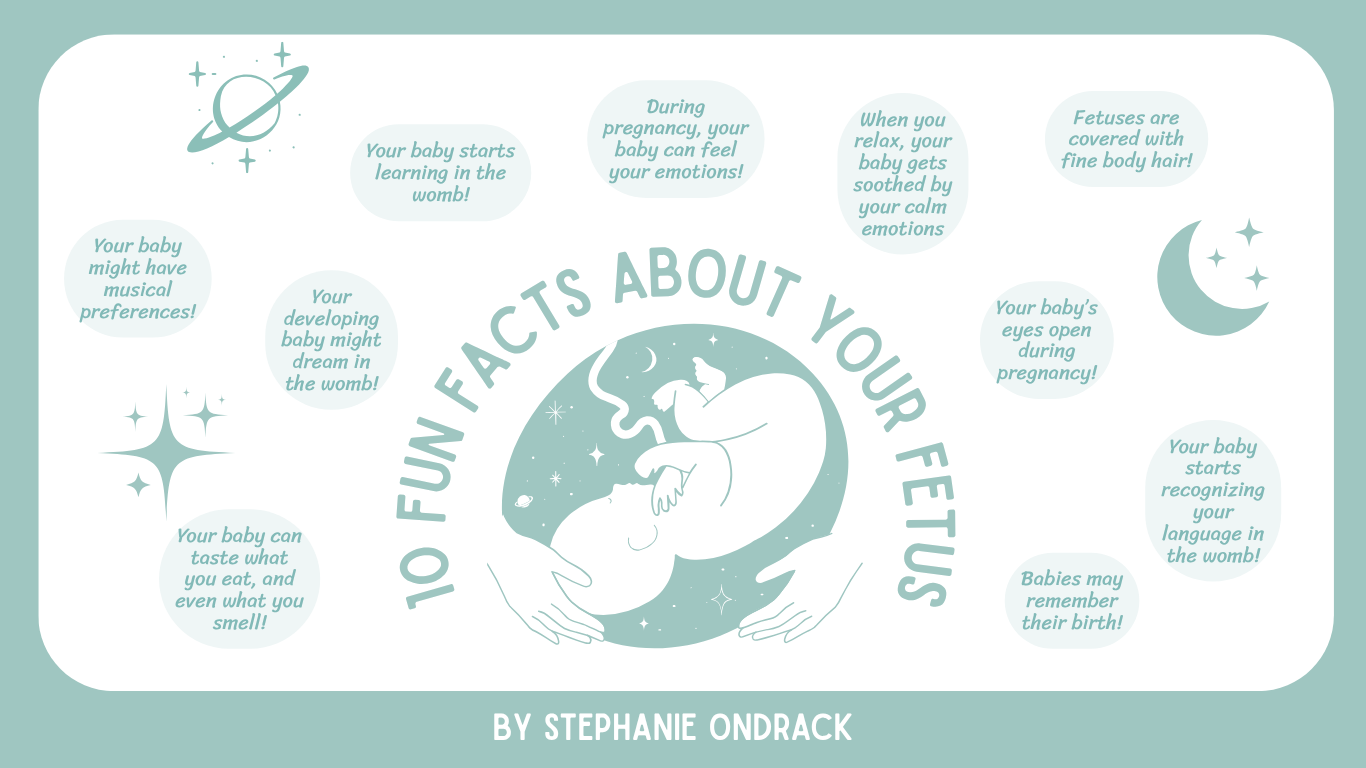
Many pregnant people receive weekly updates about their growing baby's development, often highlighting the baby's size and the exciting progress of major organs and body systems. But the journey from a single fertilized cell to a newborn is nothing short of extraordinary. As research continues, we're learning more than ever—not only about how babies develop in the womb, but also about what they experience before birth. Here are ten fascinating facts about your developing baby that might surprise you.
During pregnancy, your baby can feel your emotions!
Around the midpoint of pregnancy, fetuses begin responding to changes in the pregnant person's emotional and physiological state. Hormones such as cortisol and endorphins cross the placenta, allowing the developing baby to react to the body's physical responses to stress, calm, excitement, and other emotions. These parental emotional states influence the fetus through a complex interplay of biochemical and physiological signals.
While there is no way to know whether fetuses experience emotions such as sadness or joy in the exactly same way that older children and adults do, research suggests they do respond to the physiological changes that accompany those emotions. In other words, although a fetus may not "feel" an emotion as we understand it, it can experience and react to the physical environment created by the pregnant person's emotional state.
Your developing baby might dream in the womb!
Pregnancy certainly affects our own dreams, but whether your growing baby might also dream in the womb remains one of the great mysteries of prenatal development. Because it's impossible to measure the subjective contents of a fetus's mind, science cannot conclusively determine whether dreaming actually occurs–but the suspicion is that it does. What we do know is that fetuses begin experiencing REM (rapid eye movement) sleep between 25 and 28 weeks of gestation. During these REM periods, ultrasound studies show them moving their eyes beneath closed eyelids, twitching their limbs, and making facial expressions such as smiling or frowning. These behaviors closely resemble those seen during dreaming after birth, making it a likely conclusion that they are dreaming even before they are born.
Your baby might have musical preferences!
Your baby begins listening to you and to your world long before birth. Studies have found that fetuses exposed repeatedly to a particular song or piano melody in the womb respond differently when they hear that same music after they're born, showing recognizable changes in heart rate and behavior. Of all the sounds they hear, however, the pregnant person's voice is the clear favorite. It reaches the developing baby through both the air and the vibrations traveling through the body, making it the most familiar sound in their world. This constant exposure helps shape the neural pathways that lay the foundation for language recognition and learning after birth. So sing to your pregnant belly whenever you get the chance.
Your baby starts learning in the womb!
There is compelling evidence that fetuses can learn and form memories during the third trimester of pregnancy. Rather than studying conscious thoughts, researchers track fetal learning by measuring changes in heart rates, movement, and newborn brain activity to observe how fetuses process information from the outside world. One study found that fetuses can learn and get habituated to a sound that they hear often (like a dog barking), and that they retain the memory of it for many weeks. Another study found that after they are born, babies will recognize a story that was read to them prenatally.
Your baby starts recognizing your language in the womb!
Language learning begins before birth. By the third trimester, a fetus’s auditory system is developed enough to hear the melody and rhythm of your voice and any surrounding speech. Newborns are born with a preference for these familiar rhythms and can already distinguish their native language from other ones. Brain imaging studies reveal that listening to a language a fetus was prenatally exposed to activates the same neural language pathways as the native tongue. So if you speak two or more languages at home, your baby will be born already familiar with all of them.
Your baby’s eyes open during pregnancy!
Around 27 weeks of pregnancy, your baby's eyes open for the first time. Although the womb is a dimly lit world, they can already distinguish between light and dark and may even turn or blink in response to a bright light shone on the pregnant person's belly. It's their first glimpse of the outside world—albeit a very muted one. After birth, however, their visual journey is only just beginning. Newborns can see faces and nearby objects, but they have little to no depth perception because they have not yet had the opportunity to experience a three-dimensional world. That ability develops over the first several months as their brain learns to interpret visual information.
When you relax, your baby gets soothed by your calm emotions
Positive emotional states directly benefit fetal development. When you feel safe, happy, or relaxed, your body releases endorphins, oxytocin, and serotonin. These "feel-good" chemicals promote stable fetal heart rate variability and encourage rhythmic, healthy movement patterns. A supportive partner, strong social network, or a peaceful environment can all act as biological buffers, heavily protecting the fetal nervous system from everyday stressors. If you have a stressful job, or are going through a stressful time, even 5 minutes a day of conscious relaxation, visualization, meditation, deep breathing, or a calming walk, can help provide your growing baby with a sense of calm and safety.
Fetuses are covered with fine body hair!
Babies are covered in fine, downy hair in the womb called lanugo. It starts growing around 16 to 20 weeks of pregnancy to help protect their delicate skin from amniotic fluid and keep them warm. Lanugo acts like an anchor for vernix, the waxy, cheese-like substance that coats the baby's skin. Together, the hair and vernix insulate the baby and prevent their skin from becoming waterlogged. Most babies naturally shed their lanugo around 33 to 36 weeks of pregnancy. The shedded hair floats in the amniotic fluid, which the baby swallows, and it ultimately becomes part of their first bowel movement (meconium). About 30% of full-term babies are born with residual lanugo, usually visible on their back, shoulders, or ears. It is even more common for premature babies to be born with this hair. If your baby is born with lanugo, it will naturally disappear within the first few weeks of life.
Your baby can taste what you eat, and even what you smell!
Everything you eat, drink, and even smell during pregnancy, flavours the amniotic fluid. As your baby develops, they get used to the taste of whatever you eat and whatever you are exposed to. This is one of the ways babies get accustomed to the flavours of their family and culture, and helps to explain why some youngsters are so much more spice tolerant than others. It also might be one of several reasons pregnant people are subject to strong food aversions, and even certain odour aversions, since we might be feeling our baby’s reaction. This also might contribute to why we sometimes crave strange foods during pregnancy, if we are responding to the baby’s preferences.
Babies may remember their birth!
The field of perinatal psychology posits that even though most of us can’t consciously remember being born, the somatic experience still has an impact that is ‘remembered’ by our body and stored in our cells. Some researchers believe that the memories of birth do reside in our brains, but we have no way to access them since they were formed prior to language acquisition–thus impeding our ability to interpret the experience through a narrative. The challenge isn’t that we don’t form memories of birth, it’s that we have no way of retrieving them. Some researchers propose that most people are capable of recalling their birth under hypnosis. Certainly, there is compelling evidence that fetuses begin storing memories in the womb, so why wouldn’t they be able to remember their birth? This is still a bit of a mystery.
There are countless other fascinating discoveries about life before birth (including the remarkable phenomenon of microchimerism), but for everything we've learned, even more remains obscure. Scientists are still unraveling the complexities of fetal brain development, the "black box" of early embryonic development, and questions as intriguing as what fetuses might even dream about. The story of human development is one of the most extraordinary in biology, and we're still only beginning to understand its earliest chapters.
Stephanie Ondrack has been with The Childbearing Society since 2003. She lives in East Van with her partner, kids, cats & chickens.