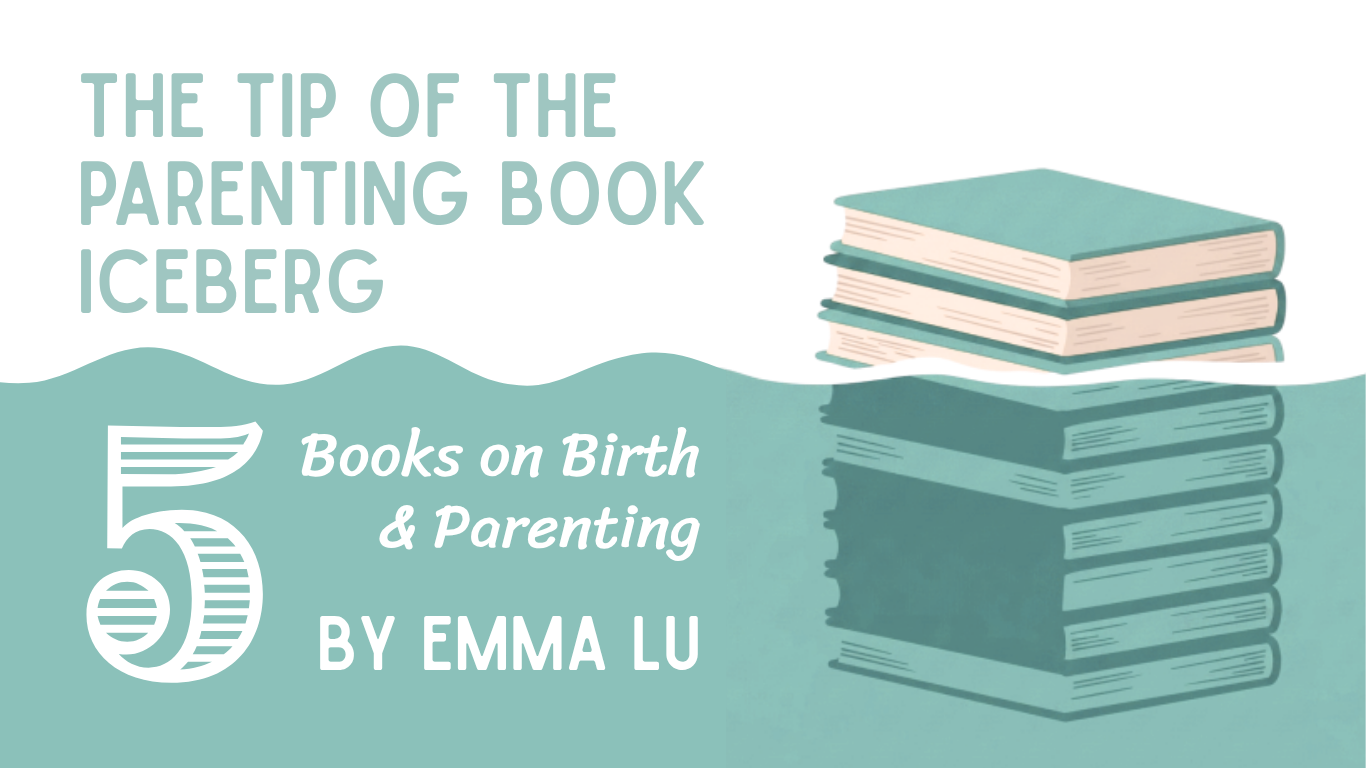
The Tip of the Parenting Book Iceberg
By Emma Lu
When I was pregnant with our first child, my partner and I talked very little about what sort of parents we wanted to be. The answer was too abundantly obvious: good ones. We came from very different families with different ideas about what we would be attempting to duplicate from the blueprints of our childhoods and what we would be intentionally leaving behind…but surely, our ideas of “good parenting” would align. I also didn’t know how to verbally communicate what specific values were important to me or how I sought to embody them or inspire them in a little person, but I did know it was very important to be a good mom. And good moms* read parenting books. Our shared naiveté and my invisible pressure created more than a few bumps in the road as we learned on the job, and left me frequently regretting our lack of meaningful conversation in advance.
What I would like to communicate now, on the other side of two pregnancies and many (possibly, daily) conversations about parenting is that parenting books are not inherently moral or immoral. They are tools for reflection, like a magazine horoscope. We may read things from parenting books written in our parents’ or grandparents’ generations that were celebrated wisdom at the time which now shock us in their absurdity or recklessness. Or, alternatively, they may impress us in their timelessness and truth. Parenting books need not be new dogmas to accept and fulfill rigidly.You can bear witness to many opinions on raising children, indeed most advice you receive will be unsolicited, and pick and choose the ideas, practices, values that resonate with your instincts and goals. You need not be a purist or perfectionist in one style exclusively to deliver an authentic, aligned, and consistent home life to your child.
I encourage you to view birth and parenting books as tools that may or may not serve a purpose to your perspective. Take each with a healthy grain of salt. Better yet - might they be conversation starters for you and your partner to reflect on your own beliefs, your childhoods, your values, and your children as individuals with varying needs and communication styles. The magic is not always in the text, but in what percolates after. My favourite way I’ve “read” a parenting book was as an audiobook in the evening hours while my husband played FIFA and I played solitaire on my phone. We paused regularly when we had something to share, and the regular input from both the author and each other helped us work toward a shared in-house philosophy. We did this for “Siblings Without Rivalry” by Adele Faber and Elaine Mazlish while expecting our second child. The process of digesting the material and reflecting together was truly meaningful for us, and we associate it with some of our greatest successes as parents. While I’d recommend that book to anyone, I recommend that style of reflection even more so.
What follows are brief reviews of two birth and three parenting books, and a recommended stage of pregnancy or age of your child for reading for maximum impact. This is the teeniest tiniest tip of the iceberg - new parents are a vulnerable market, and everyone has vital advice for you at a low, low price.
*Note: what it took to be a “good mom” and “good dad” were entirely different, I began to observe. It was optional for good fathers to read parenting books. It was neutral for mothers to read them, but simultaneously negligent if you did not.
Birth
Matrescence by Lucy Jones
Beautifully written, Lucy Jones artfully folds scientific research with prose poetry and memoir to profoundly put into words the spiritual, neurobiological, political, intensely personal metamorphosis of becoming a mother. This is a deeply validating read for anyone who feels that pregnancy, birth, and motherhood were unimaginably bigger than anyone had ever told them. It grounds that intangible feeling in reality - the ways that your brain, even your DNA, are altered by pregnancy. She shares her frustration with inherent misogyny embedded in popular culture, as well as with the medical system (speaking from the United Kingdom) which amounts to many new parents feeling bewildered and somewhat hoodwinked by what they’d been led to believe before embarking on the path to parenthood. She explores our history of medical practices from twilight sleep to epidurals, and the animal kingdom’s reproductive abilities from slime moulds to parasites in her pursuit.
Matrescence as a book and as a concept, aims to illuminate and give ceremony to the radical transformation of parenthood in all its guts and glory. It encourages readers to consider that having a baby is not simply them…plus a baby. But instead it is a transformation of self - akin to the way that a child, having gone through the aches and pains and hormones and tenderness of puberty to reach adolescence is never the same again. Matrescence is also a portal which, once through the other side, you are also born into a new self, never to return to your former. Jones feels like an older sister at times, comforting in her reassurance that motherhood doesn’t always feel entirely natural even when fulfilling, and powerful in her critique of the social and political forces that make modern motherhood what it is.
Recommended stage for reading: Anyone contemplating parenthood, currently pregnant, or perhaps in the early tumultuous months looking for the words to describe the indescribable.
Ina May Gaskin’s Guide to Childbirth by Ina May Gaskin
A foundational physiological birth book, Guide to Childbirth continues to strike a chord with readers and remains frequently recommended over decades. Written by midwife and founder of “The Farm” commune, Ina May Gaskin. It appeals to readers for Ina May’s brief introduction and closing chapters, but primarily for the middle bulk of the text which are firsthand birth stories from Ina May’s clients in the 1970s. These are many impactful birth stories told by the birthing families (sometimes written by partners) of primarily physiological births in home and birth-centre like settings. For people interested in labour without anesthesia, but doubtful of their ability - this is a tremendously powerful read. It instills readers with a sense of, “If I could do it, so can you.” That you are not the first person attempting to climb Mount Everest or unrealistic to trust in your capacity. It also reveals specific comfort measures during labour, how birthing people respond to them, and how rhythms change throughout a birth.
I often remark in prenatal classes how strange it is, in the history of our species, that the first birth many people “attend” is their own. That in the midst of their own sensations they should be wondering, “Is this normal? Is it supposed to be like this?” How different our birth culture would be if, by the time you were giving birth to your first child, you had seen your aunts, cousins, siblings, and friends give birth and were well familiarized to the sights, smells, sensations, and sounds of birth. Guide to Childbirth is a nod in the right direction of serving that purpose. In first-person narrative, you get to experience births with stress, doubt, relief, boredom, intensity, humour, spirituality, and immense joy. Sometimes all in one night.
It is also very much a product of its time. Some readers may be turned off what could be called by a written voice that is “too granola” for their taste, but if you can overlook some of the quirks of the era - there is timeless knowledge within.
Recommended stage for reading: In early pregnancy to disrupt fears around birth, or towards the end of pregnancy to gain some insight to the sensations and common rhythms of labour and instill confidence. An accessible read for birth partners curious about physiological birth.
Parenting
Bringing Up Bébé by Pamela Druckerman
This was recommended to me while pregnant with my first (or did a lot of people just seem to have it in their bags at prenatal yoga?) and I diligently read it. At the time, it seemed to have a number of helpful tips charmingly wrapped in francophile fantasy. I imagined pushing a stroller with a baguette tucked under my arm. Why not raise your baby like the French do? They are much more relaxed, sophisticated, elegant parents after all. In practice, I found it vapid and overly simplistic. It’s a better fish-out-of-water American mother in Paris memoir than genuinely supportive parenting book.
‘Le pause’ for example, to my expectant ears, sounded like the sort of simple instruction for fixing baby sleep that would set me apart from those who, sadly, did not do their reading. It instructs that when your baby fusses in their sleep at night, you simply pause, and see if their fusses escalate to a cry or if they will resolve them on their own without parental support. I assumed that by reading this book, doing my homework, I would outperform expectations and possibly, avoid difficulties altogether…? My newborn son quickly disproved that theory. In hindsight and with more experience raising two kids with different temperaments and needs, and having heard thousands of stories from friends, clients, and acquaintances about sleep - it’s clear that the sort of baby ‘le pause’ works for, is the same baby who would probably need minimal sleep support no matter what the parent did or didn’t do. But the baby for whom ‘le pause' has no l’effet will leave parents under-served and infuriated by this simplistic advice.
Other tidbits that stand out from the book was the way Druckerman compares American and French mothers’ sex appeal. Mothers are encouraged to not abandon their identities as women (as defined by dress size). Several pages are devoted to how the French view losing weight postpartum. It is all done with a wink and a nod and sense of camaraderie, but fails to adequately interrogate substantial changes in the postpartum experience beyond the superficial. Druckerman notes how many American wives feel frustration, or flat-out rage, with their mental load and lack of egalitarian domestic labour, contrasted with how French women simply find comedy and superiority in the weaponized incompetence of their husbands. She writes that French women, “view men as a separate species that by nature isn’t good at booking babysitters, buying tablecloths, or remembering to schedule checkups with the paediatrician”.
In short, Bringing up Bébé offers overly simplistic advice that won’t serve a good deal of babies, and may create unrealistic expectations for parents. If you aren’t going to be moving to France to enjoy the mandated vacation days and subsidized sliding-scale childcare as well - it has limited value in North America.
Recommended stage for reading: Before having children for a misplaced sense of optimism. Or after, for a good little laugh.
Hunt, Gather, Parent by Michaleen Doucleff
Doucleff cites a problem with prevailing Western parenting, and her firsthand experience of it. Parents and their young children are regularly engaged in power struggles, parents are burned out by unsustainable expectations, and anxiety and depression in teenagers are on the rise. There seems to be a fundamental disconnect in parent-child relationships. How did we get here as a culture, and who can we look to learn from? She travels, with her toddler, to identify major successes of parents in different cultures and incorporate their teachings into her practices. Specifically, we learn about raising helpful and community-oriented children from Maya families in Mexico, calm and regulated children (and adults) from Inuit families in the Arctic Circle, and confident and self-driven children from Hadzabe families in Tanzania.
Hunt, Gather, Parent offers a philosophical shift in the role of the toddler and child from “VIP” of the family (think: toys covering every surface of the home, weekend time spent devoted to the child’s interests, mac and cheese for dinner every night, and excessive empty praise) to valued team member trainee (think: being given developmentally appropriate tasks contributing to the family, participating in shared interests and family responsibilities, and being “seen” rather than praised). This book positions that putting children on a pedestal is not gift, instead it deprives them of their “team member badge”, and thereby a sense of deep belonging and contribution to the collective.
It also offers some philosophical shifts for parents. While you are encouraged to scaffold your child into being a helpful member of the family, the goal is not domination and total obedience, it is founded in cooperation. Children are welcome to decline tasks proposed by parents and encouraged to introduce ideas of their own that deserve parental regard and incorporation, whenever feasible. Parents are also called to confront and work to reduce their anger. To remain calm in the face of tension, and envelop children in their calm, rather than joining them in their sturm und drang. The relationship aims to transform combatants into collaborators and power struggles into group projects.
There seems to be a yearning amongst new parents for just this sort of guidance. Many parents of the 90s relied on “time outs” as punishment and chore charts as incentives. Maybe the lack of emotional processing and external reward logically leads to the rise of “gentle parenting" in the later 2010s. Gentle parenting emphasizes talking through “big feelings” when faced with tantrums, offering choices, and autonomy to encourage intrinsic motivation. Critics of this style find too many parents lean toward permissive, and that children may become overly self-focused. Now, in 2026, parents are grasping for something neither authoritarian nor permissive, not trendy or performative, but timeless and community-oriented. Hunt, Gather, Parent presents some strategies and perspectives on raising children in this manner.
Let me explain through example. When my toddler is watching me cook in the kitchen and complaining of being bored or seeking attention away from the meal I need to prepare and tensions are rising - there are several voices in my head. The 90s parent inside me wants tell her to go play alone or put on the TV for her so I can work in peace. The “gentle parent” inside me wonders if I should pause making our breakfast and getting her brother to school on time to sit with her feelings, name them, and attend to them. Or perhaps, buy her a lovely little Montessori-inspired play kitchen with $60 wooden fake fruits to fake cut in fake half with a fake knife, and feeling subsequently guilty I won’t spend our real money on that. The Hunt, Gather, Parent parent inside me identifies that she is looking for a way to connect with me and participate in the task at hand, and also that the responsibilities to our group render us unable to cater to this individual exclusively, though she needs support finding her direction. That parent gives her a real banana to slice with a butter knife, alongside my work. If she is too young for that, she can pack into a carrier and observe me cooking. If she is older and more capable, she can set the table for the family. She has a purpose and a role in our family, and we all contribute together to our family group project.
Recommended stage for reading: Parents of 1-3 year olds have the most to gain, but within the book strategies for families with older children (7 and up) are offered as well. I would hesitate to suggest this book in pregnancy or the newborn stage when some of the ideas may feel too abstract.
The Book You Wish Your Parents Had Read (and Your Children Will Be Glad That You Did) by Phillipa Perry
A powerful and (sometimes painful) read that urges parents to consider the experiences of their childhoods and how it may be relived through parenting their children. What memories and beliefs you may have inherited that, without introspection, will be bequeathed unintentionally. Perry is a psychotherapist and mother and draws on her qualifications to provoke empathizing with the experiences of children deeply (your inner child included).
The book is structured fairly chronologically, from your own childhood and formation of your inner voice to the family life environment of your child, the foundations of pregnancy and the immediate postpartum, well into toddlerhood and childhood with attention to sleep needs, tantrums, and boundaries. There’s even a bit about screen time.
A highlight of the book are the many anecdotes and examples of its concepts in practice. A mother carrying groceries in from the car who, overstimulated and hurried, snaps at her daughter and seeks to repair. A father who, faced with his son’s disappointment and sadness, has to get comfortable with feeling uncomfortable emotions in order to comfort, though his own early programming tells him to “look on the bright side” at all times. It finds triumph in day-to-day, but by no means small, moments of parents catching themselves in a harmful cycle and making a more nurturing choice. It encourages parents to allow children the full range of emotion available on the human spectrum, and not demand happiness at all times, but to be with them in their hard times. It encourages parents to recall how they received love and criticism as children and how that colours their lives, for good or for ill, as adults.
This is best suited for parents who are confronting their own childhoods with new eyes while raising their children, which I expect, is essentially everyone.
Recommended stage for reading: During pregnancy and into the first year of parenthood. This is a “book club” style read that benefits from both individual processing time, and a reading partner to discuss it with.
We often hear people say, “there’s no guidebook to being a parent” and at it’s most literal, I have to disagree, there are obviously thousands. Everyone has an opinion, conscious or unconscious, solicited or unsolicited, about what constitutes “good parenting” and how children should be raised. Some people take their opinions and write books on the topic, and others will just cast disapproving glances at your developmentally normal toddler causing a Oscar-worthy scene in the cereal aisle because you already have Cheerios at home and they can’t eat them here. You will never satisfy the standards of all onlookers - the requirements are too often contradictory. Thankfully, that is not your purpose. Your job is to define and satisfy your standards and values for your family of creation. When people say, “there’s no guidebook to being a parent”, my more charitable understanding is that they mean “there’s no guidebook to parenting your specific child”. It’s not on the market, your child is unique and you are their expert. In a sense, you are the author of that book. Across the hundreds and thousands of guidebooks on how to parent, your task is to write, and continue amending, the living guidebook of your child. How does my child demonstrate responsibility? What is my child learning about the world around them? How does my child find purpose, connection, regulation, and meaning? How does my child feel loved by me? How does my child express love to others? How do these questions and answers change at six months old, six years old, sixteen years old, thirty-six years old..? This handbook will require updating as they grow, and will not be the same as their sibling’s handbook, nor yours as a child. I encourage you to read a parenting book or few, reflecting with others if possible, only as a means of source material as you author or co-author the frequently revised, heavily earmarked and annotated, beautiful book of your child.
Emma is an instructor with The Childbearing Society, former birth doula, and mother of two.