
When you have a baby, your life changes very drastically and suddenly. It affects your brain, your body, your time, your routines, your priorities, your relationships, and your sense of self. It is no wonder that becoming a parent for the first time has a profound effect on your emotions.
While postpartum depression, anxiety, psychosis and the spectrum of diagnosable conditions often make the headlines, it is the garden-variety emotional effects that are far more common, and for which we are severely lacking in reliable support.
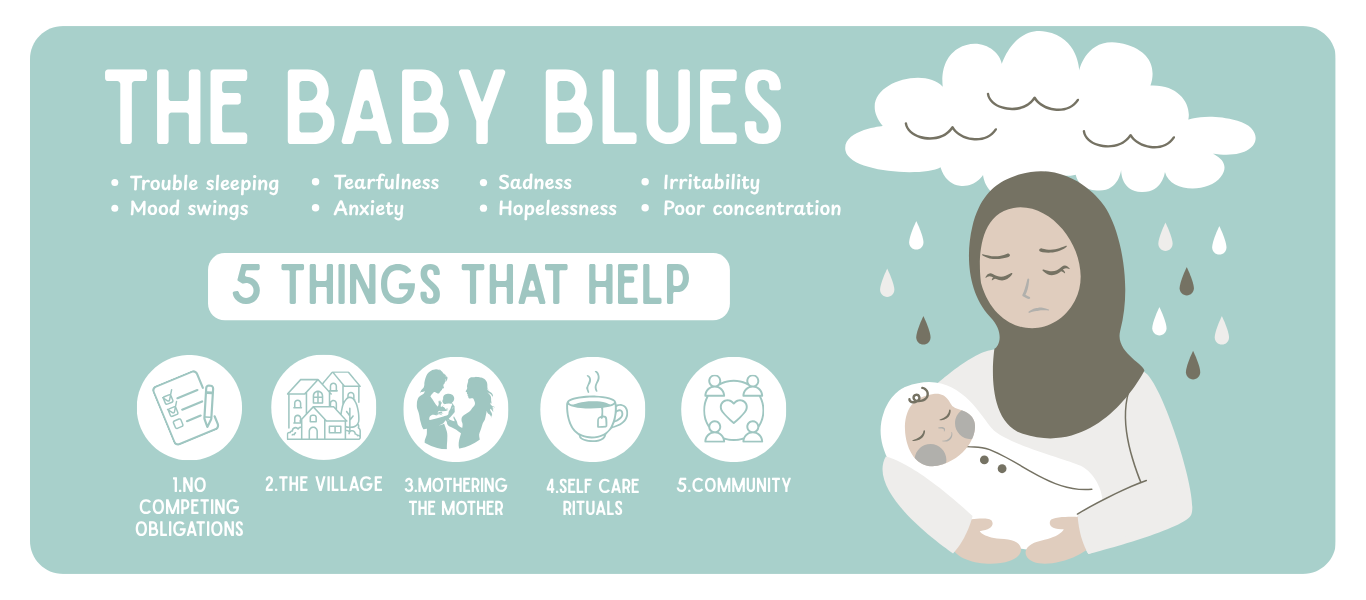
You may have heard of the ‘baby blues’, which is an inadequate term for the range of postpartum emotions that many people experience. This would be a typical list of Baby Blues symptoms:
Trouble sleeping
Mood swings
Tearfulness
Anxiety
Sadness
Hopelessness
Irritability
Poor concentration
It is considered normal to feel this way for the first week or two, but if symptoms persist beyond that, of if symptoms feel so severe that you are having trouble coping, it is always worth checking in with your caregiver (doctor or midwife) in case it is postpartum depression, which affects at least 15% of new parents.
For the so-called normal baby blues, there are a few things you can do that help. We’re going to highlight five of them.
No Competing Obligations
The immediate postpartum phase can be so intense that some people find it nearly impossible to get anything else done–including having a shower, eating an apple, or walking the dog. If you can eliminate the majority of competing obligations for the first week or two after your baby is born, this can significantly reduce your stress-load, and hence your postpartum experience.
Before your baby arrives, consider brainstorming all the ways in which you can avoid housework. What can you outsource to friends and family, what can you outsource to professional services, what can you do now instead of later, and what can you simply skip for the first week or two. Think about meals, pet care, dishes, vacuuming, grocery shopping, etc.
If you were planning to work from home, is it possible to take a break first, maybe a few weeks where you can just focus on your body, your baby, and adjusting to this massive life change. And if you were planning to work on your thesis, or build a fence, consider building in some time to delay these projects until you actually feel ready to take them on.
The Village
We know it takes a village to raise a child, but in our world that places a very high value on autonomy & independence, it can be hard to adjust to leaning on the community. It can even be hard to identify the community. If you are lucky enough to have helpful friends and family nearby, say yes to all offers of help. This can involve some personal re-training, but we really do need to accept help in the first few weeks postpartum, as the demands of a newborn can be intense.
Another source of postpartum help can be professionals and services. House cleaners, dog-walkers, Uber-eats, postpartum doulas… people you hire can play an integral role in your postpartum village. We might need to seek out or acquire help as well as accept it when it’s offered.
Mothering the Mother
These suggestions overlap a bit in practice, but each one has a different emphasis. We know from research that when a new mother is cared for, her needs are met, and she feels nurtured and supported, her emotional adjustment throughout the postpartum period is improved. This goes beyond having a cleaning service vacuum your floors. It’s more about checking in with the new mother, bringing her tea and food, listening to her, providing encouragement, support, and reassurance.
When we are looked after, we have more nurturing energy to extend to our baby. Whereas when we are running on empty, it is much harder to care for our little one. This ‘mothering-the-mother’ role can be filled by partners, friends, family, grandparents, siblings, but also consider engaging a postpartum doula. In these days when many of us live far away from family, postpartum doulas serve a vital function of filling that consequential gap. Postpartum doula hours make a great baby shower gift.
Self Care Rituals
Sometimes simple things like having a bubble bath all to yourself, or strapping your baby into a soft carrier and going for a walk with music, can help hold the line between barely coping and actually thriving. We don’t get a lot of time to ourselves during the postpartum phase – we don’t even get a lot of hands-free time – so it is worth thinking of little rituals that help you feel replenished or replete. Maybe this is a morning coffee routine, or fifteen minutes to read your book, or a half-hour mid-day nap. It might even be hiring someone to give you a neck massage in your home. During the early weeks think small, but know that me-time does get easier as your baby grows and their need for you becomes less intense.Another aspect of self-care might involve what to avoid. Specifically, I would consider curating your social media algorithms, or limiting your exposure to posts that are designed to induce stress or worry. Parental concern makes for irresistible click-bait, which means new parents are an extremely vulnerable target market for posts that are manufactured to provoke feelings of anxiousness.
Even well intentioned parenting books can make you feel like you’re doing everything wrong, and make you question all your instincts. It can be useful to remember that raising babies didn’t seem to require expert opinions until recently in human history. The internet can be a wonderful source of information but sometimes self-care involves unplugging for a bit, and listening to your baby and your gut instead. Unlike social media programming, your baby has no secondary agenda.Community
One of the main things that has been shown to help with the Baby Blues, or postpartum emotional adjustment, is joining a group for new parents. There is something incredibly reassuring about being in a room with other people who are going through the same experience. Suddenly, the things that felt strange, overwhelming, or even a little frightening become much more normal. You realize that you are not the only one who cries for no apparent reason, worries constantly about your baby, or finds the transition to parenthood harder than expected.
Peer support groups offer something that even the most loving and well-meaning family and friends sometimes cannot: the reassurance of shared experience. They provide a space where new parents can speak honestly, ask questions, share their struggles, and celebrate the small victories with people who truly understand. There is no need to explain why you are exhausted, why you haven't showered, or why something that seems insignificant to someone else feels enormous to you. These connections can reduce feelings of isolation, build confidence, and help new parents feel less alone during an emotionally vulnerable time.
At The Childbearing Society, we believe these connections are an important part of postpartum wellbeing. Having a baby is a huge life transition, and it was never meant to be navigated in isolation. Sometimes simply hearing another parent say, "Me too," can make all the difference.
Conclusion
The postpartum period is a time of enormous adjustment, and we need to do a better job of recognizing and supporting the emotional needs of new parents. While the Baby Blues are common, that doesn't mean they are insignificant, or that new parents should simply be expected to muddle through on their own.
Practical help, a nurturing support network, opportunities for rest, small moments of self-care, and connections with other new parents can all make a meaningful difference. And perhaps most importantly, we need to normalize the idea that becoming a parent can be emotionally difficult, even when it is something we have wanted and looked forward to.
If you are expecting a baby, think about your postpartum support before your baby arrives. Build your village, make a plan for accepting help, and find opportunities to connect with other new parents. You deserve to be cared for, too.
And remember: if your feelings are overwhelming, getting worse, or persisting beyond the first couple of weeks, please reach out to your doctor or midwife. You don't have to wait until things become unbearable to ask for support.
Stephanie Ondrack is a retired birth doula (or maybe on an extended sabbatical) and has been with The Childbearing Society since 2003. She lives in East Van with her partner, kids, chickens, and cats.