
15 Hacks for An Easier Birth
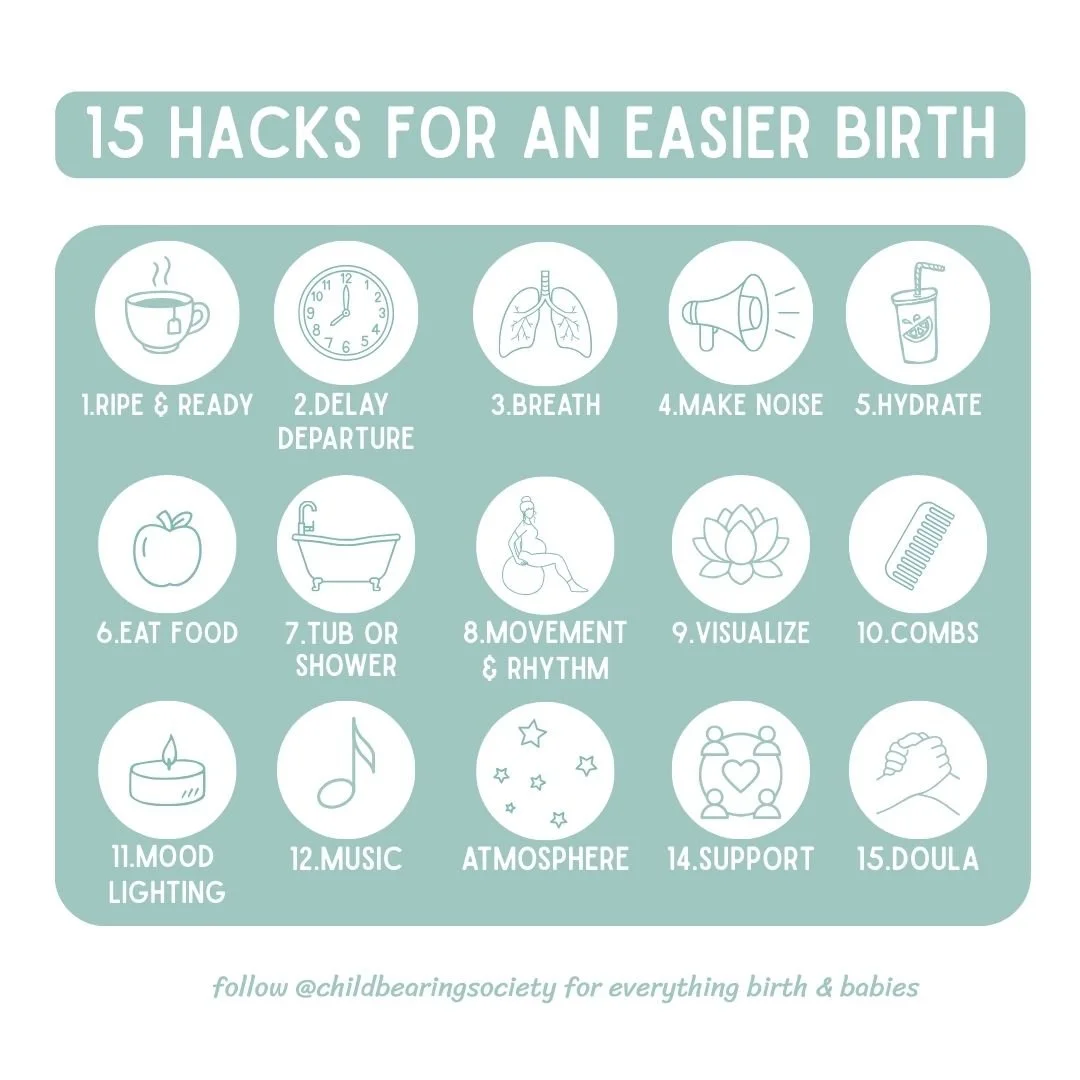
If your due date is fast approaching and you’re a bit nervous about giving birth, you might be wondering if there is anything uncomplicated that you can do to help make your birth a little easier. Good news. There is! Even though birth itself is impossible to fully plan or predict, there are quite a few simple and low-tech hacks you can use to stack the odds in your favour for an easier, smoother, and more pleasant birth experience. The ones listed here are all things you can do at home as well as in the hospital, and don’t require anything complicated or expensive
Ripe & Ready
Even before labour starts there are some things you can do to help pave the way for an easier birth. No guarantees, of course, but any of these things might stack some odds in your favour. Some people get acupuncture treatments prior to labour, to help their bodies prepare for the process. Some people consume dates or evening primrose oil capsules to help the cervix soften. Some people drink raspberry leaf tea to help tone the uterus. Some people do lots of walking, prenatal yoga, or dancing, to help get the baby into the right position. And some people get prenatal massages to get the blood and oxytocin flowing. Romantic evenings, candlelight dinners, and slow dancing can also help generate oxytocin. It’s hard to gauge the exact efficacy of any of these hacks but all of them could help you have a shorter, easier, or more efficient labour.
Delay Departure
Aim to get to the hospital when you‘re well into active labour (approximately 6cm dilation). If you get to the hospital when you’re just at the beginning of active labour (approximately 4 cm dilation), you’re less likely to get a room, and more likely to have to wait in the triage or assessment area. Plus, it’s more common for labour to stall from the change in environment if labour isn’t well enough established when you make the move. Finally, you won’t know your actual dilation–you’ll be guessing based on external signs like timing contractions and the birthing person’s mood & behaviour–so it is extremely common to head to the hospital too early (less than 4cm dilation). If this happens, you get sent home again. This can be crushingly disappointing, as well as uncomfortable, since the stressful car ride and the atmospheric interruptions can both compromise your oxytocin flow, causing your labour to stutter and possibly show down or stall, and also be a really difficult experience. If you are hoping for a quicker birth, stay home until you’re well into active labour, upping your odds of getting assigned a hospital room immediately upon arrival, with minimal interruption to your labour progress. Check out this post if you’re wondering how to tell if you’re in active labour.
Breath
If you see a prenatal class in a movie, the one cliche you will always see (other than sitting on the floor), is breathing preparation: hee, hee, hee, hoo. In reality, you don’t actually have to make these sounds. But conscious breath awareness can be really helpful. A couple easy techniques include:
Circle breathing–slowly breathe in through your nose, and then out through your mouth. Every time you breathe out, relax a little bit more. Breath out any tension in your jaw and bottom.
2/6 breathing–breathe in through the nose for a count of 2, and breathe out through the mouth in short, staccato exhalations for a count of 6. Picture your out-breath relaxing your body downwards from head to bottom.
J-breathing–breathe in through the nose, and then breathe out in a tight mouth, making a “fffff” sound, and imagine you are inflating a balloon. As you do so, feel how this breathing puts pressure on your pelvic floor. Now try it again while purposefully relaxing the pelvic floor, so all the pressure is coming from your diaphragm.
Make Noise
Along with your breathing, consider making noise, vocalizing, or ‘toning’. Some people find that being really loud is their best coping tool. Try letting your voice rumble forth from the depths of your gut, so that you’re making loud, low, vowel sounds during contractions, sounds that reverberate through your whole body and make your belly vibrate with the tones. Some people find that they have no choice, as if the sounds are summoned from their bodies spontaneously, beyond their control. If your body wants to make noise, don’t fight it. Don’t be afraid to be loud. Let your power roar.
Hydrate
Believe it or not, this is really crucial to an easier labour. The uterus is a muscle and like any muscle, it doesn’t work optimally when it is suffering from dehydration. Labour is a heavy-duty endurance activity, and you want to ensure that all your muscles, especially the mighty uterus, are as well supported as possible for the big event. Muscles can cramp up when overly parched, and you will be physically miserable if you add thirst to your list of discomforts. Stay well hydrated throughout labour by drinking water, and also electrolyte beverages such as coconut water, juice, sports drinks, or ‘labourade’. Partners and support people can offer you a drink after every contraction to ensure that you stay well-hydrated from beginning to end.
Eat Food
Labour is a little like going on an arduous, all-day hike. It is a lot of work, it is tiring, and it takes a huge supply of energy. Just like you would probably bring snacks for a long hike, it is a very good idea to eat throughout labour. Some people have an instinct to load up on fuel (often carbs) in pre-labour. In fact, if you notice that you have a suddenly enormous appetite towards the end of your pregnancy, this can sometimes be a clue that early labour is near. But during active labour, a lot of people find their appetite slows down, and it can be harder to remember to eat. This is another good job for partners or labour support people, who can offer you a small mouthful of food every few hours, just to keep your strength up. You can eat whatever appeals to you, but if nothing does, some popular labour foods include popsicles, apple sauce, yogurt, raw nuts, dates, smoothies, honey sticks, or bananas. If you don’t eat, it is hard to labour on an empty fuel tank, and you risk feeling unnecessarily depleted, exhausted, and ‘hangry’. Even just a couple raw almonds and a date every few hours can help give you the energy to carry on, and prevent your labour from stalling from lack of fuel.
Tub or Shower
Soaking in a tub during labour used to be called ‘the midwives epidural’ because it is so very effective at reducing the feeling of contractions. The floating sensation can soften the heavy, gravity impact of pregnancy and labour; the water all over our skin has a gate-control effect by drawing our awareness away from the pain; and soaking in a bath has a profoundly relaxing, restorative, replenishing influence on our state of mind. Lots of people use a relaxing bath to unwind after a difficult day. It has this same soothing, comforting and calming effect during labour. A shower, similarly, provides a cleansing, refreshing, rejuvenating experience, and during labour it can also work on gate-control, muting your awareness of contractions with multiple pinpoints of water drops. People with long, slow labours often prefer the relaxation of the bathtub, whereas people with fast, precipitous labours sometimes prefer the spray feeling of the shower. You can lie, stand, or sit in the tub or shower however you are most comfortable, but one popular position is to kneel while leaning forward on a birth ball, either in a shoulder-deep tub, or under a cascading shower. If you do this, consider placing a yoga mat down first, to save your knees from getting sore.
Movement & Rhythm
When you are experiencing contractions, you might have a strong urge to sway or rock your way through them. Many people do this instinctively because it feels soothing, provides comfort, and helps with coping. If you are sitting or leaning on a birth ball, you might rock back and forth, or side to side rhythmically during each contraction. If you are standing, or leaning against a table, wall, or a support person, you might move your hips in circles or up and down. Whatever feels right is the right thing to do. But movement often feels better than stillness because we are responding to the pressure in the pelvis that is caused by the baby moving downwards and getting into position for the birth. We feel pressure on one side, and we instinctively lean away from it, to create space, or an open passage, for the baby to continue moving down. You might find one position that works for you for a long time, until suddenly it doesn’t, and you need to try some other ones. Some people sway and dance to the tune of their own inner labour, and some people use classic labour positions such as slow dancing, leaning forward, kneeling, sitting on a ball, or lunging.
Visualize
One of the most classic labour hacks is to visualize something helpful during contractions. This one is traditional because it is effective, but also because so many people do it spontaneously, without planning to. A few classic visualizations include:
A flower opening: picture a flower opening petal by petal. This helps our body open in response.
Floating: picture that each contraction is a wave, and you are floating and relaxing into each one, letting them come, letting them be strong, letting them wash over you.
Golden light: picture that each contraction is warm golden light that builds in your belly, warming you, melting any tension, growing until your whole body is beaming with golden light, and then slowly dissipating and receding, dimming and flickering out.
Hiking: picture that you are hiking or walking up a steep hill during each contraction, which helps your body & brain contextualize the muscle work, effort, and challenge of labour in a way that makes sense and is familiar and non-threatening.
Combs
This is a simple one. Squeeze combs in your hands. Line the comb up with your palm, so the teeth or tines are in the middle of your hand, and squeeze tight during every contraction. This works on gate-control, providing an alternative sensation for your brain to focus on, but also helps us release endorphins, which help us cope with labour. You can use any kind of comb, including the cheapest dollar-store plastic ones, but some people prefer stronger ones made of wood or metal. Have two combs ready, one for each hand.
Mood Lighting
Our mammal brains know the script for labour, but sometimes we have to get our modern human brains to step aside in order to allow the trance-like state to take over. One powerful way to help us do this is to dim the lights. A lot. The appearance of a night sky helps us relax, and helps us find the zone where our thinking brain cedes control to our instinctive brain. It’s similar to your mental state when you’re in bed, deeply relaxed, almost asleep, and your thoughts are wandering aimlessly and dreamily. We want to evoke the sleepy, trance-like state during labour because it helps unlock our body and mind’s instinctive coping mechanisms. The appearance of a night-sky contributes to this. Dim the lights, or use mood lighting to really set the tone. While you’re at home, candles work wonderfully to establish relaxing lighting. You can’t bring anything with an open flame to the hospital, so good alternatives include electric (fake) candles, or lanterns. Some people bring a string or two of fairy lights and drape them in the hospital room. And some people bring dollar-store light projectors that cast a twinkly glow on the walls. Or, you can just turn off the room lights and let a thin beam from the bathroom provide some soft illumination. These are all effective ways of using lighting to create a sleepy, dreamy mood in the room that can help you achieve the trance-like state that makes labour more bearable.
Music
Music is a very popular hack for labour. Not only can music be relaxing, transporting, mood-setting, and wonderfully distracting, but it can support the rhythmic movements you are probably already doing, and help your brain get into that dreamy state. As a bonus, music can help muffle all the other sounds that might be distracting or disturbing, such as machines beeping, footsteps in the hall, people chatting, or someone birthing in the next room. Sometimes, external sounds can snap us out of our labour trance (such as a sudden or a suspicious sound), and sometimes external sounds can be highly annoying, which prevents us from relaxing into that hypnotic state (such as people talking, or a door repeatedly squeaking). It’s similar to how trying to fall asleep can be interrupted by unexpected or irksome sounds. Music can help buffer us from that potential disruption.
Atmosphere
The trance-like state I keep mentioning, often called ‘labourland’, is like the mental state you might get when you’re on a long run and you’re not really thinking; your mind is just drifting comfortably and you have no real sense of time passing. Your body is on auto-pilot. In labour, we go deep inside our bodies, and our awareness becomes internal rather than external. Or at least we have the capacity to do this, but only if the conditions are conducive for it. We have to be able to sink into the limbic system of our brain, which entails letting go of our cognitive functioning (the higher brain), as well as giving up awareness of our reactive or ‘safety’ functions (the lower part, the brain stem). To do this, we have to feel totally comfortable, safe, and secure. We need similar conditions to falling asleep–physical comfort, feeling safe, feeling completely uninhibited, no time pressure, and no interruptions. One thing that really helps us get there, is creating a comfy, cozy nesting environment that feels familiar and safe to all of our senses. This is easy to do at home. You probably can immediately picture where you feel cozy and restful in your home, and what your comfort items would be. Creating this effect at the hospital takes a bit more planning and creativity. You want to bring stuff from home that communicates safety and familiarity to all of your senses, so that the hospital room looks, feels, smells, and sounds like your safe nesting place. Consider bringing things to look at, comfort items like pillows, blankets, & slippers, things that smell like home (or smell lovely), and things that make you feel deeply comfy, cozy, and relaxed. A bonus is that whatever atmosphere you create will be reflected by anyone who enters the room. If you have dim lights and soft music, they will enter quietly and respectfully. Try to create an atmosphere that makes you feel completely safe and comfortable.
Support
Another important consideration for creating your sense of comfort and safety is who you have around you when you are in labour. Think about who makes you feel safe, who you trust to take care of you, to anticipate your needs and wishes, you can speak for you if you are unable to, and who you feel completely uninhibited with. Also consider the dynamics between your chosen support people. For example, if your spouse and your best friend don’t get along, any tension between them might have a negative impact on your experience. You are allowed to have as many support-people as you want. Many people choose more than one, since labour can be very long and it is a lot for one person to carry solo, but inviting too many observers can make our bodies feel shy, and can prevent us from achieving that labourland headspace that thrives in privacy and intimacy. Give some thought as to who you would like to be present.
Doula
As well as your partner or a close friend/relative to support you, I would strongly suggest considering hiring a doula. Doulas can be the pivotal difference that facilitates a good birth, not just in terms of experience but also in terms of outcomes. Doulas bring their knowledge, experience, and a sense of calm to your birth. Most people labour at home for a long time before it is time to go to the hospital, and it can be unnerving to not know what is normal, or what is safe. Partners can find it very stressful if there is bleeding, or the birthing person is very loud, or they see mucous plug and don’t know what’s okay and what’s not. Having a doula present can take the stress off having to make these judgments, or trying to figure out when to head to the hospital or to call the midwife. Having a doula at your birth also demonstrably and statistically improves outcomes: healthier baby, healthier parent, fewer medical interventions, less pain, shorter labour, fewer complications. Plus, a doula can help you with all the hacks listed above, even if you forget all them the minute contractions start. Doulas can help your partner remember how to provide the best labour support, with the partner shining memorably and the doula working quietly in the background.
None of these hacks can guarantee what kind of birth you will have, but any or all of them can contribute to helping your birth be a little bit smoother, a little bit easier, and a little bit more comfortable. There are many more where these came from. Consider enrolling in our prenatal classes to learn them all.
-Stephanie Ondrack is a retired birth doula (or maybe on an extended sabbatical) and has been with The Childbearing Society since 2003. She lives in East Van with her partner, kids, chickens, and cats